Last Wednesday, I unwillingly took part in a typical Chielan experience—I was robbed. I was carrying my cell phone in my sweater pocket at a market, felt a tug, looked down, and had no phone. I went to a mobile police unit, filed a police report, and went home. I am completely fine, no worries, but currently phoneless in Buenos Aires…although I am going to buy a new phone when I get back to Santiago.
We are in Buenos Aires for our last two weeks of the structured program, and it feels more like a vacation than work. We have interesting academic seminars, school visits, and educational excursions—more on those later—but we also have significantly more free time than we did in Santiago. It is really relaxing, and a good break for all of us before our Independent Study Projects begin.
I haven’t taken much time to talk about our group as a whole, although it has been a huge part of this experience. Brief overview: there are fifteen of us, fourteen girls and one guy, from all over the US. Hampshire is the only school doubly-represented (go Hamp!) and, although most go to schools on the East Coast, a few go to schools scattered across the Midwest and West. I feel really fortunate that in a group of fifteen, we all get along well enough to go out to dinner together, or to just hang out after class. I’m so happy that it’s worked out this way—that I feel comfortable with everyone, one-on-one or in a group; that I never feel self-conscious about my opinions on education or politics, even though they differ significantly from others’.
It’s really strange that, on November 6th, I will no longer be in this group to which I have become very accustomed, and that, chances are, I will be spending a significant amount of my ISP alone in Temuco. This is both exhilarating and nervewracking, but probably the best thing that will happen for my Spanish language skills.
Since arriving in Buenos Aires, I, along with other people from the group, have started to notice my English grammar and spelling going out the window. I think in English words but with Spanish grammar, for example: “I will go to the house of Kim at nineteen hours” or something like that. And I think about almost all of my conjunctions in Spanish nowadays—so if I come home saying “entonces” (so, anyway) all the time, please forgive me.
Entonces. If Santiago is a South American version of Brooklyn, then Buenos Aires is definitely Upper West Side Manhattan. There are trees and everyone is thin and beautiful. People always say it is very European, which it is—but it really reminds me of the area in Manhattan by Central Park.
I’m really enjoying living with my new host family—it is the polar opposite of living with Mercedes, but it is good just the same. I am living with a single mother, Andrea, and her nineteen-year-old daughter, Agostina, in a relatively large apartment in a nice area of the city. Agostina is studying musical comedy and circus arts, with a focus on trapeze, and is a lot of fun to hang out with. (Tonight I’m going to her dance class, where I will learn the “Thriller” dance!) I’ve met a few of her friends, who are all really nice, and we went to see some of her classmates in a show the other day—so I feel like I’m experiencing Buenos Aires differently than I’ve experienced Santiago. It is incredibly different living with someone my own age—good different, but it’s not that the alternative is bad.
Agostina and Andrea are both out of the house until pretty late at night, so I usually am the first to get home—which is fine with me, it’s just a big change from Mercedes, who is always around. Also, food isn’t nearly as big of a deal here—usually the family just eats dinner together, at around ten p.m.
That’s pretty much all that is going on these days—although tomorrow we will be going on a very special educational excursion, marching with the Madres de la Plaza de Mayo. We got to sit down for a chat with one of the original founders of the organization yesterday, which was amazing—and I will post about it soon…I definitely recommend reading about them, they are incredible women and their organization is one of the most interesting and influential human rights organizations in the world:
http://en.wikipedia.org/wiki/Mothers_of_the_Plaza_de_Mayo
http://www.madres.org/ (in Spanish)
Showing posts with label meeting new people. Show all posts
Showing posts with label meeting new people. Show all posts
Wednesday, October 28, 2009

Wednesday, October 21, 2009
Temuco Reflection
Ever since I’ve known enough to know that Yiddish is dying, I’ve been upset that I have scraped by in life without knowing much more than a schlep and an oy vey. My mom’s parents are fluent, but my mom and her brothers never learned much—and my cousins, my sister and I know nothing. I think the same thing has happened with Mapudungun, the traditional language of the Mapuche people. Parents teach their children Spanish first, because, frankly, it’s more useful in the world—and eventually, the old language is all but forgotten.
Perhaps the biggest surprise that awaited us in Chapod was the lack of traditional Mapuche culture that we had been learning about for weeks. We had been told that our host parents would speak limited Spanish, that Mapudungun would be their first language; we had been prepared to eat typical Mapuche foods, particularly lots of pork and lamb; and we had learned a bit about the Mapuche religion, which is very interesting (more on that later.) However, we arrived to families who no longer know Mapudungun, cook similar food to our host families in Santiago, and are devout Evangelicals.
The Evangelical Church came around a few generations back, and my family swears that it rid the community of some of its biggest problems, including effectively eliminating alcoholism in Chapod. But, with it went the Mapuche religion, and later Mapudungun. Kids now are scraping by with a mari mari (hello) and kofke (bread.) They learn English as their second language in schools, because it’s more of an asset in the global community than their own language. What will their kids have, if this generation is getting by with so few words? Probably the same as my kids will: a memory of a language so far past it seems almost irrelevant.
I see this as a net loss. But I am an outsider, so who am I to judge? I never saw the old ways, so how can I know if I’m idealizing them?
My host dad, Raul, is the principal of the elementary school we visited in Chapod, and a devout Evangelical. The family said or sang grace before all meals, and everyone was very involved in the Chapod’s one church. My host mom, Luci, like most of the women in the community, doesn’t work. My host sister, Mabel, is thirty-two and in her third year of university in the city of Temuco (where she studies music,) and she is very nice and friendly. My host brother, Ruly, was very interesting to say the least. He’s twenty-eight, and also in his third year of university, studying theater. He is one of the founders of a national theater company that educates youth about the four most present indigenous groups in Chile: the Penhuenche in the East, the Picunche in the North, the Huilliche in the South, and the Mapuche in the West. He’s also in a band called Kechu Werken with his cousins, the youngest of whom is thirteen years old…they do covers of Chilean music using traditional Chilean instruments.
In the traditional Mapuche religion, there are two main forces present: el mapun, or the energy of the cosmos, and el chen, human energy and will. Both are present inside each human being, and both have a side that is male and a side that is female. In the Mapuche faith, woman came before man, and thus has a certain power—and 90% of Mapuche religious officials are women called machi, who are healers.
Taking this into account, I was shocked to find a very strong machismo attitude and an everpresent feeling of antifeminism while in Chapod. For the first time in my life, I was very aware of being in a “woman-in-the-kitchen, man-in-the-workplace” culture—and not only this, but a society where the man is valued more than the woman.
They start young. Annick, Lizzie, and I taught an English lesson in a fifth grade classroom of four students—two boys and two girls. The girls said close to nothing throughout the class, while the boys were clearly more animated and charismatic. The girls were shy, reluctant to share their opinions, and hesitant even when asked direct questions. “What do you want to learn about today?” Shrug. We talked about animals. “Do you have cats in your house?” One word answer.
In my family’s house, I saw it as well—my host mom was very timid, and barely spoke above a whisper to anyone. I rarely saw her outside of the kitchen or dining room, except when she was outside collecting eggs from her hens. It was clear that my host dad had all the power in their relationship, and he would oftentimes speak for her. While my host brother and host sister both attended the same university, Ruly lived in Temuco during the week, while Mabel commuted to school every day so she could be home to help her mother with the house.
In the community, even during program-sponsored activities, I saw even more. One activity we partook in was a game of palin, a traditional Mapuche sport which is kind of like field hockey. After everyone from SIT was given sticks, community members, including kids from the school were invited to join…but only males were given sticks. We were then asked to team up, and a ten-year-old girl, Carolina, who I had been talking to asked if she could be on our team, to which I said of course, although we didn’t have a stick for her. So I played for ten minutes or so to be polite, and then I asked Roberto if I could give Carolina my stick so she could play. He kind of shrugged, but gave me the go-ahead…so I gave her my stick and she played in the game.

I still feel weird about it. I feel weird that I asked and feel weird that I had to ask. It’s another big who am I question: Who am I as some gringa feminist, educated at a private college in the United States, raised in a completely different world, to come into Chapod, Chile and give a little girl a palin stick?
Don’t get me wrong though, I had an excellent time in Temuco. It was refreshing to be back in the countryside, to breathe fresh air, and to play soccer in a field where, every once in awhile, a pig would wander by. And, even though I witnessed a lot of things I perceive as negative, I think I’ve gained a lot of insight into a world that I had never even heard of before two months ago. Net gain? Maybe.
Learn to Count to Ten in a Dying Language (Mapudungun 101):
Kiñe - 1
Epu - 2
Küla - 3
Meli - 4
Kechu - 5
Kayu - 6
Regle - 7
Pura - 8
Ailla - 9
Mari - 10
Favorite Photos from Temuco:


Perhaps the biggest surprise that awaited us in Chapod was the lack of traditional Mapuche culture that we had been learning about for weeks. We had been told that our host parents would speak limited Spanish, that Mapudungun would be their first language; we had been prepared to eat typical Mapuche foods, particularly lots of pork and lamb; and we had learned a bit about the Mapuche religion, which is very interesting (more on that later.) However, we arrived to families who no longer know Mapudungun, cook similar food to our host families in Santiago, and are devout Evangelicals.
The Evangelical Church came around a few generations back, and my family swears that it rid the community of some of its biggest problems, including effectively eliminating alcoholism in Chapod. But, with it went the Mapuche religion, and later Mapudungun. Kids now are scraping by with a mari mari (hello) and kofke (bread.) They learn English as their second language in schools, because it’s more of an asset in the global community than their own language. What will their kids have, if this generation is getting by with so few words? Probably the same as my kids will: a memory of a language so far past it seems almost irrelevant.
I see this as a net loss. But I am an outsider, so who am I to judge? I never saw the old ways, so how can I know if I’m idealizing them?
My host dad, Raul, is the principal of the elementary school we visited in Chapod, and a devout Evangelical. The family said or sang grace before all meals, and everyone was very involved in the Chapod’s one church. My host mom, Luci, like most of the women in the community, doesn’t work. My host sister, Mabel, is thirty-two and in her third year of university in the city of Temuco (where she studies music,) and she is very nice and friendly. My host brother, Ruly, was very interesting to say the least. He’s twenty-eight, and also in his third year of university, studying theater. He is one of the founders of a national theater company that educates youth about the four most present indigenous groups in Chile: the Penhuenche in the East, the Picunche in the North, the Huilliche in the South, and the Mapuche in the West. He’s also in a band called Kechu Werken with his cousins, the youngest of whom is thirteen years old…they do covers of Chilean music using traditional Chilean instruments.
In the traditional Mapuche religion, there are two main forces present: el mapun, or the energy of the cosmos, and el chen, human energy and will. Both are present inside each human being, and both have a side that is male and a side that is female. In the Mapuche faith, woman came before man, and thus has a certain power—and 90% of Mapuche religious officials are women called machi, who are healers.
Taking this into account, I was shocked to find a very strong machismo attitude and an everpresent feeling of antifeminism while in Chapod. For the first time in my life, I was very aware of being in a “woman-in-the-kitchen, man-in-the-workplace” culture—and not only this, but a society where the man is valued more than the woman.
They start young. Annick, Lizzie, and I taught an English lesson in a fifth grade classroom of four students—two boys and two girls. The girls said close to nothing throughout the class, while the boys were clearly more animated and charismatic. The girls were shy, reluctant to share their opinions, and hesitant even when asked direct questions. “What do you want to learn about today?” Shrug. We talked about animals. “Do you have cats in your house?” One word answer.
In my family’s house, I saw it as well—my host mom was very timid, and barely spoke above a whisper to anyone. I rarely saw her outside of the kitchen or dining room, except when she was outside collecting eggs from her hens. It was clear that my host dad had all the power in their relationship, and he would oftentimes speak for her. While my host brother and host sister both attended the same university, Ruly lived in Temuco during the week, while Mabel commuted to school every day so she could be home to help her mother with the house.
In the community, even during program-sponsored activities, I saw even more. One activity we partook in was a game of palin, a traditional Mapuche sport which is kind of like field hockey. After everyone from SIT was given sticks, community members, including kids from the school were invited to join…but only males were given sticks. We were then asked to team up, and a ten-year-old girl, Carolina, who I had been talking to asked if she could be on our team, to which I said of course, although we didn’t have a stick for her. So I played for ten minutes or so to be polite, and then I asked Roberto if I could give Carolina my stick so she could play. He kind of shrugged, but gave me the go-ahead…so I gave her my stick and she played in the game.

I still feel weird about it. I feel weird that I asked and feel weird that I had to ask. It’s another big who am I question: Who am I as some gringa feminist, educated at a private college in the United States, raised in a completely different world, to come into Chapod, Chile and give a little girl a palin stick?
Don’t get me wrong though, I had an excellent time in Temuco. It was refreshing to be back in the countryside, to breathe fresh air, and to play soccer in a field where, every once in awhile, a pig would wander by. And, even though I witnessed a lot of things I perceive as negative, I think I’ve gained a lot of insight into a world that I had never even heard of before two months ago. Net gain? Maybe.
Learn to Count to Ten in a Dying Language (Mapudungun 101):
Kiñe - 1
Epu - 2
Küla - 3
Meli - 4
Kechu - 5
Kayu - 6
Regle - 7
Pura - 8
Ailla - 9
Mari - 10
Favorite Photos from Temuco:


Saturday, October 10, 2009
Time
I don’t understand time, and I never have. One day twenty-four hours go by so slowly that it is hard to focus, other days speed by so quickly that I don’t know where the time went. Sometimes it’s a combination of the two. But twenty-four hours never feels like exactly twenty-four hours. I’ve never looked at a week and said, “That felt like a week.” There’s always a modifier—“That felt like a long week,” “That week felt like two days,” “I can’t believe how slowly that week went by!” It’s always been “Why is time going so slowly,” or “I can’t believe how quickly time has gone.”
I can’t believe how quickly time has gone. I have been in Chile for over six weeks, now. The first part of our program is finished, and with it our Spanish classes, our seminar at Universidad Alberto Hurtado, our first practicum, and the significant portion of our Santiago homestay.
Tonight, Geoff’s family hosted a big fiesta for all of the students and their homestay families. It was really wonderful to finally meet everyone’s families—and was great to converse with new people—new patient people—in Spanish. And of course, because we’re in Chile, there was a dance party in the backyard—complete with Chilean, American, and British music (at one point “I Wanna Hold Your Hand” by the Beatles started playing), a conga line, and plenty of energy.
Tomorrow night, we leave for Temuco. We will be staying in a community called Chopod, living with one other student and a Mapuche family who may or may not have electricity or running water (and definitely don’t have internet…which will probably be my biggest struggle.) We will be attending workshops on intercultural and bilingual education, human rights, and the Mapadungun language. I am so excited for this portion of the trip—although I hear they eat even more in Temuco, and are still offended if you don’t eat everything. But I am very excited to get out of the city, and be back in the country—fresh air sounds fantastic. Below is a map of Chile—Santiago is in the second red area, Region Metropolitina, and Temuco is in the ninth region (Araucania.)

Also tomorrow night—Daylight Savings Time. As of right now, Chile is in the same time zone as New York, but beginning tomorrow we’ll be two hours apart (New York moves forward, Chile moves back.) As I said, I don’t understand time.
I can’t believe how quickly time has gone. I have been in Chile for over six weeks, now. The first part of our program is finished, and with it our Spanish classes, our seminar at Universidad Alberto Hurtado, our first practicum, and the significant portion of our Santiago homestay.
Tonight, Geoff’s family hosted a big fiesta for all of the students and their homestay families. It was really wonderful to finally meet everyone’s families—and was great to converse with new people—new patient people—in Spanish. And of course, because we’re in Chile, there was a dance party in the backyard—complete with Chilean, American, and British music (at one point “I Wanna Hold Your Hand” by the Beatles started playing), a conga line, and plenty of energy.
Tomorrow night, we leave for Temuco. We will be staying in a community called Chopod, living with one other student and a Mapuche family who may or may not have electricity or running water (and definitely don’t have internet…which will probably be my biggest struggle.) We will be attending workshops on intercultural and bilingual education, human rights, and the Mapadungun language. I am so excited for this portion of the trip—although I hear they eat even more in Temuco, and are still offended if you don’t eat everything. But I am very excited to get out of the city, and be back in the country—fresh air sounds fantastic. Below is a map of Chile—Santiago is in the second red area, Region Metropolitina, and Temuco is in the ninth region (Araucania.)

Also tomorrow night—Daylight Savings Time. As of right now, Chile is in the same time zone as New York, but beginning tomorrow we’ll be two hours apart (New York moves forward, Chile moves back.) As I said, I don’t understand time.
Monday, August 31, 2009
Home!
I’ve officially moved into my new home here in Santiago! I’m living with a woman named Mercedes, who is in her sixties, in her apartment in Santiago Central (downtown Santiago.) Mercedes is absolutely wonderful. For the past two days, we’ve been walking around Santiago and she’s been showing me interesting places and how to get around the city. I am her eleventh homestay chica, so I think she has this whole first-few-days thing down.
Mercedes is a really incredible person—besides being a wonderful homestay mom, she is a writer (she has written a novel, a memoir, and a lot of unpublished poetry (although one of her poems is in an anthology), a mother of four and grandmother of nine, and a political and human rights activist. She has an amazing story, although I don’t know all of it—I do know a bit about her husband, Ivan. Ivan was a socialist, and was assassinated by the government in 1973, about ten days after Pinochet took over. Mercedes was left alone with three young children, and was still pregnant with her youngest son at the time (or he had just been born). This is the subject of her memoir, and I really look forward to reading it one day when my Spanish is good enough. (I’ve been looking for a link to the book, but I can’t find one. I will post when I do.) I know that she’s still very politically involved, which is exciting because there’s a big presidential election coming up in December, and I’m very excited to learn a lot about the political situation here. Even with this background, Mercedes is very upbeat and happy—she laughs a lot, and is very kind and patient with me and my poor Spanish skills.
Yesterday, when we were walking around, we saw a wedding and sat in on the ceremony…I felt a bit like I was in Wedding Crashers, but in a completely benevolent way. It was a really beautiful ceremony, and I understood bits and pieces…and the bride and groom were very happy. This was the first first wedding I’ve been to—the rest have been second weddings—so it was really exciting. Mercedes kept joking that we should put on party dresses and follow the guests to the after party!
Today we walked around for a bit and saw one of Pablo Neruda’s other houses—turns out he has three: Isla Negra, the one we saw as a group a few days ago, Las Caschona, here in Santiago, and Sebastiana, which is in Valparaiso, a bit north of here. (As a side note, Las Chascona was the nickname of Neruda’s third wife, Matilda, and it has something to do with her crazy curly hair…I’ve finally found a word to describe the texture of my hair! It doesn’t translate very well, though, I don’t think.)
I had my first big Spanish challenge today—trying to buy a phone card to call home. I still have no idea what happened in that exchange, or how to use the card, but I do know that I can’t use it to call the States and that it cost 5,000 pesos (a bit less than $10.) Thank goodness Mercedes was there to help out with that one. I have my Spanish placement test tomorrow morning, and I’m a bit nervous…but I figure that whatever level I wind up placing in I’m going to improve a whole lot. Even over the past two days I felt strong improvement, and I’ve been learning a lot of vocabulary.
That's all for now! I have internet in the apartment (it was less challenging to get WiFi internet for my computer than a phone card) so I will probably be posting more frequently than I thought! Buenos noches!
Mercedes is a really incredible person—besides being a wonderful homestay mom, she is a writer (she has written a novel, a memoir, and a lot of unpublished poetry (although one of her poems is in an anthology), a mother of four and grandmother of nine, and a political and human rights activist. She has an amazing story, although I don’t know all of it—I do know a bit about her husband, Ivan. Ivan was a socialist, and was assassinated by the government in 1973, about ten days after Pinochet took over. Mercedes was left alone with three young children, and was still pregnant with her youngest son at the time (or he had just been born). This is the subject of her memoir, and I really look forward to reading it one day when my Spanish is good enough. (I’ve been looking for a link to the book, but I can’t find one. I will post when I do.) I know that she’s still very politically involved, which is exciting because there’s a big presidential election coming up in December, and I’m very excited to learn a lot about the political situation here. Even with this background, Mercedes is very upbeat and happy—she laughs a lot, and is very kind and patient with me and my poor Spanish skills.
Yesterday, when we were walking around, we saw a wedding and sat in on the ceremony…I felt a bit like I was in Wedding Crashers, but in a completely benevolent way. It was a really beautiful ceremony, and I understood bits and pieces…and the bride and groom were very happy. This was the first first wedding I’ve been to—the rest have been second weddings—so it was really exciting. Mercedes kept joking that we should put on party dresses and follow the guests to the after party!
Today we walked around for a bit and saw one of Pablo Neruda’s other houses—turns out he has three: Isla Negra, the one we saw as a group a few days ago, Las Caschona, here in Santiago, and Sebastiana, which is in Valparaiso, a bit north of here. (As a side note, Las Chascona was the nickname of Neruda’s third wife, Matilda, and it has something to do with her crazy curly hair…I’ve finally found a word to describe the texture of my hair! It doesn’t translate very well, though, I don’t think.)
I had my first big Spanish challenge today—trying to buy a phone card to call home. I still have no idea what happened in that exchange, or how to use the card, but I do know that I can’t use it to call the States and that it cost 5,000 pesos (a bit less than $10.) Thank goodness Mercedes was there to help out with that one. I have my Spanish placement test tomorrow morning, and I’m a bit nervous…but I figure that whatever level I wind up placing in I’m going to improve a whole lot. Even over the past two days I felt strong improvement, and I’ve been learning a lot of vocabulary.
That's all for now! I have internet in the apartment (it was less challenging to get WiFi internet for my computer than a phone card) so I will probably be posting more frequently than I thought! Buenos noches!
Friday, August 28, 2009
Por Fin, En Chile!
Hola, todos! I am blogging now from a very colorful hotel room in Algarrobo, Chile, a small town about an hour outside of Santiago. We are right on the Pacific ocean, and the beach is beautiful…but the weather is way colder than I thought it would be. According to my Celsius-Fahrenheit converter it is currently 73.4 degrees outside, but that is a lie. It feels like it’s about 50, and we’re all bundled up in sweaters and hats and crowded around a space heater. But regardless, things here are great, and I am very happy I chose to spend my semester here in Chile.
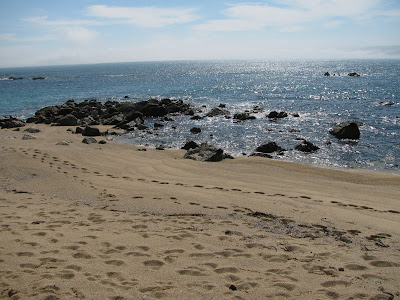
I am going to backtrack for a bit and talk about the process of actually getting here. After spending all day Tuesday trying not to vomit from nervousness, I woke up on Wednesday morning incredibly excited to leave. With one notable exception with a bank issue and a near-breakdown mid-afternoon, I was ready to go, ready to get on the ten-hour plane, and ready to begin this semester-long adventure. Essentially I was sick of the nerves, and knew that as soon as I got here they would go away.
As soon as I got to the gate, I began chatting with two other girls from the program and the Miss Universe contestant from Tanzania (who is not on our program, but was waiting for a plane at our gate). All three were very nice and easy to talk to! It turned out that the other two girls (as well as most of the people on the program) have the same worries I do, which was comforting. The two (Lizzie and Kim) were actually two of the only people from the program who I had really spoken to before, so it was funny that we were all on the same plane.
The actual plane ride wasn't horrible, but it was ten hours overnight and I didn't exactly sleep. But I did watch Grease in Spanish, which was fantastic--although the songs were in English, which was disappointing.
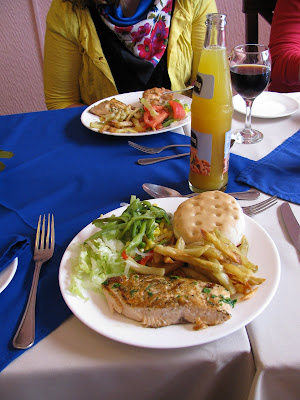
The past two days have been filled with orientation and getting-to-know-you activities. It's really fascinating, because even though everyone involved in the program is interested in the themes of education and social change, our specific interests lie in completely different areas. One girl is interested in bilingual education and speech pathology, and another is studying peace studies and thinks that education is a clear route to peace, and another is interested in human rights in indigenous communities. We’ve been speaking a lot of Spanish during orientation, although we’re still speaking English to each other. My Spanish is better than I thought, but still not great, so I’m excited for that to begin improving. And the food is delicious!
Interesting Facts I Have Learned about Chile in the Past Two Days:
After orientation, the group took a trip to Pablo Neruda’s house. It was amazing for two main reasons: first being the obvious, it was incredible to see where he sat and wrote his poetry and came up with his ideas; and the second was because he was absolutely insane and collected everything. We have a store in the town where I grew up called the Eclectic Collector—and I swear it must have been inspired by Neruda. He collected, among other things: masks, pipes, miniature models of guitars, alcohol bottles, ships-in-bottles, and seashells.
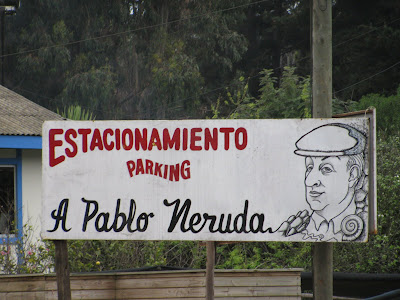
Tomorrow we will meet our homestay families, and I am very excited. Right now I have very little information about my family, so I will post about them when I know more. Hasta luego!

I am going to backtrack for a bit and talk about the process of actually getting here. After spending all day Tuesday trying not to vomit from nervousness, I woke up on Wednesday morning incredibly excited to leave. With one notable exception with a bank issue and a near-breakdown mid-afternoon, I was ready to go, ready to get on the ten-hour plane, and ready to begin this semester-long adventure. Essentially I was sick of the nerves, and knew that as soon as I got here they would go away.
As soon as I got to the gate, I began chatting with two other girls from the program and the Miss Universe contestant from Tanzania (who is not on our program, but was waiting for a plane at our gate). All three were very nice and easy to talk to! It turned out that the other two girls (as well as most of the people on the program) have the same worries I do, which was comforting. The two (Lizzie and Kim) were actually two of the only people from the program who I had really spoken to before, so it was funny that we were all on the same plane.
The actual plane ride wasn't horrible, but it was ten hours overnight and I didn't exactly sleep. But I did watch Grease in Spanish, which was fantastic--although the songs were in English, which was disappointing.
The past two days have been filled with orientation and getting-to-know-you activities. It's really fascinating, because even though everyone involved in the program is interested in the themes of education and social change, our specific interests lie in completely different areas. One girl is interested in bilingual education and speech pathology, and another is studying peace studies and thinks that education is a clear route to peace, and another is interested in human rights in indigenous communities. We’ve been speaking a lot of Spanish during orientation, although we’re still speaking English to each other. My Spanish is better than I thought, but still not great, so I’m excited for that to begin improving. And the food is delicious!

Interesting Facts I Have Learned about Chile in the Past Two Days:
- Chile has fifteen separate regions, two of which are very new.
- Chile is one of the most developed and one of the wealthiest countries in South America; however the rich/poor divide is among the worst in the world (it comes in 10th place). It is as follows:
- The richest 20% of the country has 64% of the country’s wealth
- The poorest 20% of the country has 3.2% of the country’s wealth
- The poorest 40% of the country has only 9.6% of the country’s wealth.
- Chile is the world’s largest producer of copper
- 10% of the current Chilean population is Mapuche, an indigenous people who live in a region in Northern Chile
- Under Allende, Chile was a socialist country, and offered many socialized programs. But after the coup de 1973, Pinochet changed the Chilean constitution to change the role of the state to a subsidiary of programs (such as educational programs) rather than a provider.
- Chilean gas is imported from Bolivia, via Argentina—so it is very, very expensive.
- The Jewish community in Chile is one of the largest in Latin America, but it's very much unseen. Chile isn't very religious in general; although it is technically a Catholic country, the majority of the people--particularly those in Santiago--observe Catholicism as tradition rather than belief.
- The concept of sexual harassment is very new in Chile—the only law in place in the country was instituted in 2005, and only deals with boss/employee relations. (Can you tell we had a discussion about sexual harassment and machismo?)
- Chileans speak very quickly.
After orientation, the group took a trip to Pablo Neruda’s house. It was amazing for two main reasons: first being the obvious, it was incredible to see where he sat and wrote his poetry and came up with his ideas; and the second was because he was absolutely insane and collected everything. We have a store in the town where I grew up called the Eclectic Collector—and I swear it must have been inspired by Neruda. He collected, among other things: masks, pipes, miniature models of guitars, alcohol bottles, ships-in-bottles, and seashells.

Tomorrow we will meet our homestay families, and I am very excited. Right now I have very little information about my family, so I will post about them when I know more. Hasta luego!
Subscribe to:
Posts (Atom)
